CHAPTER II
DISCUSSION
A
paragraph is made up of sentences grouped together for a reason—usually to
present and support a single main idea.
Like us, paragraphs are individuals—each has a
purpose of its own. However, each of the
paragraphs in a composition is also like a member of a team, working together
with other paragraphs to develop ideas. We
might think of a paragraph as a link in a chain—separating, yet connecting,
ideas.
The
paragraph was used in ancient Greek texts to mark each place where a new topic
was introduced. Today, paragraphs are
used in much the same way—to divide an essay or article into blocks of separate
thoughts or to divide a story into a series of events.
In
fact, even though we do not think much today about why we use paragraphs, they
are very important tools. Paragraphs
provide a visual sign to the reader that a new thought—or new speaker—is
coming. They also allow readers to take
a little pause to digest what they’ve read so far. When we are writing, we
might think of paragraphs as a way to lead our reader by the hand through
our essay.
2.2 Understanding Paragraph
Although
some paragraphs—especially in narrative writing—do not have a central focus,
most paragraphs do emphasize one main idea.
Paragraphs like this, often called body paragraphs, usually have three
major parts: a topic sentence (a
statement of the paragraph’s main idea); additional
supporting sentences that elaborate on and support the topic sentence; and
(often, but not always) a concluding, or clincher
sentence.
a. Topic Sentence
A topic sentence at the
beginning of the paragraph helps a reader know what to expect in the rest of
the paragraph. Usually it located in the beginning of paragraph.
Topic sentences at the
beginning of the paragraph provide clues about what to expect in the rest of
the paragraph. When we
are writing, topic sentences help us focus the ideas in our
paragraph. Also, whether we
are writing a paragraph or reading one, the topic sentence can suggest
the order of details in the paragraph—order by comparison-contrast or by cause
and effect, for example.
b. Supporting
Sentences (Elaboration)
The topic sentence of a
paragraph states the general idea. To
make that idea clear and interesting to the reader, you have to elaborate on
it, or develop it in greater detail.
Other sentences in the paragraph give specific details or information to
support the main idea of the paragraph.
Depending on the subject you are writing about, you might support your
main idea with sensory details, facts, statistics, or specific instances or
examples.
c. The Clincher
Sentence
You should end paragraphs
with a sentence that emphasizes the paragraph’s topic sentence or main
idea. This concluding sentence is called
a clincher sentence because it pulls all the details together and signals that
the end of the paragraph has come—often using a transitional word or phrase such
as therefore, as a result, and consequently.
The
diagram below shows the typical three-part structure of a body paragraph that
begins with a topic sentence.

A
good paragraph has three major qualities, they are:
·
Unity:
All
the parts of the paragraph work together as a unit to express and support one
main idea. Sentences can work as a unit in one of three ways: (1) by
supporting a main idea that is stated in a topic sentence, (2) by supporting a
main idea that is implied (not directly expressed), or (3) by expressing a
related series of actions.
·
Coherence:
The
ideas in the paragraph are arranged and connected in a way that will make sense
to readers. We can create coherence by paying
attention to two things: (1) the order;
or organizational pattern, in which we
arrange our ideas, and (2) the connections
we make between ideas.
·
Elaboration:
The
paragraph’s main idea is developed or expanded using plenty of supporting
details. Remember
that a good paragraph should contain supporting sentences that elaborate on the
main idea presented in the paragraph’s topic sentence. However, sometimes do not thoroughly develop,
or elaborate on, a paragraph’s main idea; these writers fail to provide enough
sensory details, facts, and statistics, or examples. A paragraph with a poorly supported main idea
is said to lack elaboration.
2.3 What is Patterns of Organization?
Patterns
of organization is how is information is organized in writing. It is important
to identify with the author's perspective by discovering the way the message is
being sent. Every writer has a purpose for writing and some plan of
action for getting a message across. This plan of action is the order in
which the material will be presented in the text. This order, often
called a pattern of organization, should be present in acceptable writing from
the smallest to the largest unit of writing: the paragraph, groups of paragraphs,
sub-chapters, chapter, group of chapters, whole books, and even series of
books. Each of these, then, contains a certain pattern of organization.
2.4 Patterns of
Organization and Their Clue Words
Patterns of organization not
only vary from writing to writing, but it may also change frequently from
paragraph within a single piece of writing. We will cover five common types of
patterns of organization.
a. Chronological Order
When information in a passage is organized by the time in which each event
occurred, it is organized chronologically. Certain passages in a story may focus on
describing scenary or spaces, and use a descriptive or spatail method of
organization. Items are listed in the order in which they occurred or in a specifically
planned order in which they must develop. In this case, the order is
important and changing it would change the meaning.
The conflict of a story may be
discussed in terms of problem and solution or cause and effect, but the text in
a story is still mainly organized chronologically.
The clue words are: first, before, after, when, later, at last.
Example:
This morning was crazy. My
alarm clock was set for PM instead of AM, so I woke up really late. I just
threw on some clothes and ran out the door. I rode my bike as fast as I could
and thought that I was going to be late for sure, but when I got there everyone
was outside and there were fire trucks all lined up in front of school. I guess
somebody pulled the fire alarm before class started. It worked out though,
because nobody really noticed or minded that I was tardy.
b. Compare and Contrast
Compare and Contrast is a text structure or
pattern of organization where the similarities and differences of two or more
things are explored. It is important to remember that with the compare and
contrast text structure the text should be discussing similarities and
differences. The text must do both to be considered compare and contrast.
The clue words are: similar, different,
on the other hand, but, however, in the same way, like, unlike.
Example:
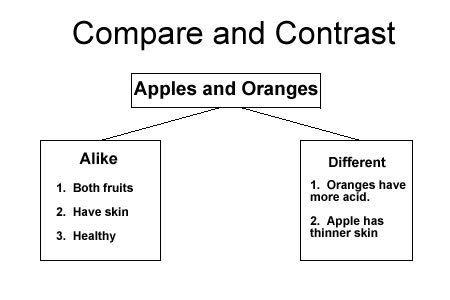
Apples and oranges
are both fruits, which mean that they have seeds inside of them. Each has a
skin, but orange skins are thick and easy to peel. Apple skins are thinner and
do not peel easily. Oranges also contain more acid than apples, but both fruits
are delicious.
c. Cause and Effect
In this pattern,
one item is showed as having produced another element. An event (effect)
is said to have happened because of some situation or circumstance
(cause). The cause (the action) stimulates the event or effect (the
outcome).
Paragraphs structured
as cause and effect explains reasons why something happened or the effects of
something. These paragraphs can be ordered as causes and effects or as effects
and then causes. The cause and effect text structure is generally used in
expository and persuasive writing modes.
The clue words are: for this reason, consequently, because, on that account,
as a result, therefore, however.
Example:
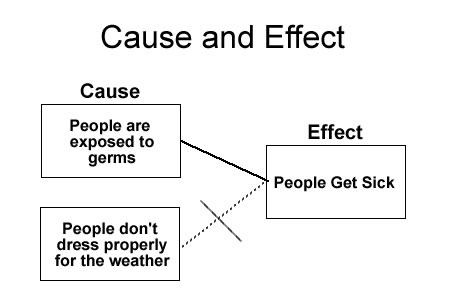
Many people think that they can get sick by going
into cold weather improperly dressed; however, illnesses are not caused by
temperature- they are caused by germs. So while shivering outside in the cold
probably won’t strengthen your immune system, you’re more likely to contract an
illness indoors because you will have a greater exposure to germs.
d. Spatial
Spatial
organization is when information in a passage is organized in order of space or
location. If we were to
describe the room in which we
were sitting right now, we
would be using spatial organization. Spatial organization may also be called
descriptive writing and it is most frequently used when the narrator describes
how something looks. Spatial
organization is generally pretty easy to identify, but be aware that spatial
organization is used in both fiction and nonfiction texts. Most fictional passages are organized
chronologically, but in paragraphs where the narrator is describing a setting
or the appearance of a character, the information may be organized spatially.
The clue words are: next to, behind,
across from, below that, above that, to the right of.
Example:
Volcanoes are a
feared and destructive force for good reason.
A volcano is like a pressure valve for the inner earth, but they can
also be very beautiful. One part of the
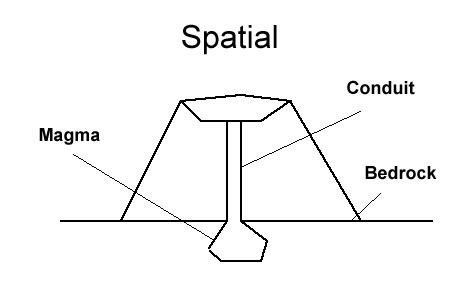
volcano that people rarely see is the magma chamber. The magma chamber is way
beneath the Earth’s bed rock. It is
tremendously hot. Running from the magma chamber to the crater of the volcano
is the conduit. The conduit connects the magma chamber to the outer world. At the top of the volcano is the crater. This
is where the magma exits. Volcanoes are a beautiful yet dangerous natural phenomenon.
e. Sequence
Sequential
order, or process writing as it is sometimes called, is when information in a
passage is organized by the order in which it occurs. This method of organizing
text is generally used for instructions or directions, but it can also be used
to explain processes in nature or society,
Sequential
organization is frequently confused with chronological order. To further
confound the issue, sometimes people refer to chronological order as
chronological sequence. But there is a key difference that distinguishes the
two patterns: texts organized chronologically occur at a specific time and
setting, whereas texts describing processes or sequences do not occur at any
specific time and place. Unlike chronologically ordered texts, information
organized sequentially does not occur at any specific time but, rather,
anytime.
The clue words are: First, next,
before, lastly, then
Example:
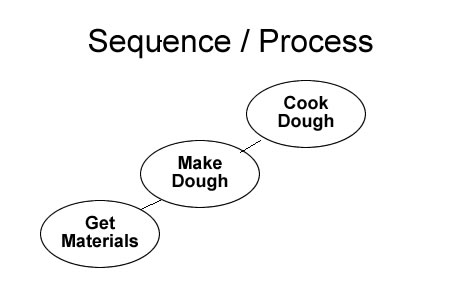
These are the way of how to make a cookies.
First, get your materials. Then, make your dough. Lastly, cook your dough at
400 degrees for 10 minutes.
2.5 Exercises
After
understanding the materials above, let’s do some exercises below. Just analyze
the paragraphs and decide the right patterns for each paragraph.
1. As you
might already know, there is no direct intermixing of blood between a mother and
her unborn child. However, some substances—especially drugs—can still have a
powerful effect on the fetus. If, for example, the mother is addicted to
morphine, heroin, or methadone, the baby may be born with the same addiction.
For that matter, even high doses of aspirin appear to have some effect on the
fetus. In at least one study, high doses of aspirin have been linked to lower
IQs in infants.
2. In a
study of happiness, researcher Jonathan freedman asked a hundred people to give
their definitions of happiness. The results of Freedman’s study suggest that
people really do differ in how they define happiness. About half of Freedman’s
subjects spoke of happiness in terms of excitement and good times. To them,
happiness was a life full of fun. The other half, however, thought of happiness
in terms of contentment, satisfaction, or freedom from worries. For these
people, happiness was peace of mind. Yet while some stressed pleasurable
activity and others stressed quiet contentment, the difference was really a
matter of emphasis. Almost everyone agreed that both good times and peace of
mind are central to being happy. (Adapted from Rubin et al., Psychology,
p. 420.)
3. After
opening the door to the pantry, which measures five feet by five feet, there
are five shelves spaced evenly apart, one above the other. On the lowest shelf,
heavier items have been placed. The sugar is to the left, and the flour is
situated to the right of it. On the next shelf up there are many canned goods
which cover that entire shelf. On the next shelf above that, many different
varieties of bottled water and juices are present. The next shelf up contains
assorted types of dried pasta which are stacked in rows next to each other. On
the shelf above the pasta are jars of pasta sauce pushed to the left of the
shelf. On that same shelf are foods like muffins and other treats. There are
also some larger bottles of water sitting on the floor under the lowest shelf.
Let’s see
the right answer.
1. The
paragraph is in cause and effect pattern.
The paragraph describes how taking of drugs by a pregnant woman may negatively
affect the well-being of her baby.
2. The
paragraph is in comparison and contrast
pattern. As the topic sentence (sentence 2) states, the paragraph contrasts two
different definitions of happiness people gave in a study.
3. The
paragraph is in spatial pattern. The
paragraph describes the view of pantry clearly, and also we can find the
spatial clue words.

Tidak ada komentar:
Posting Komentar